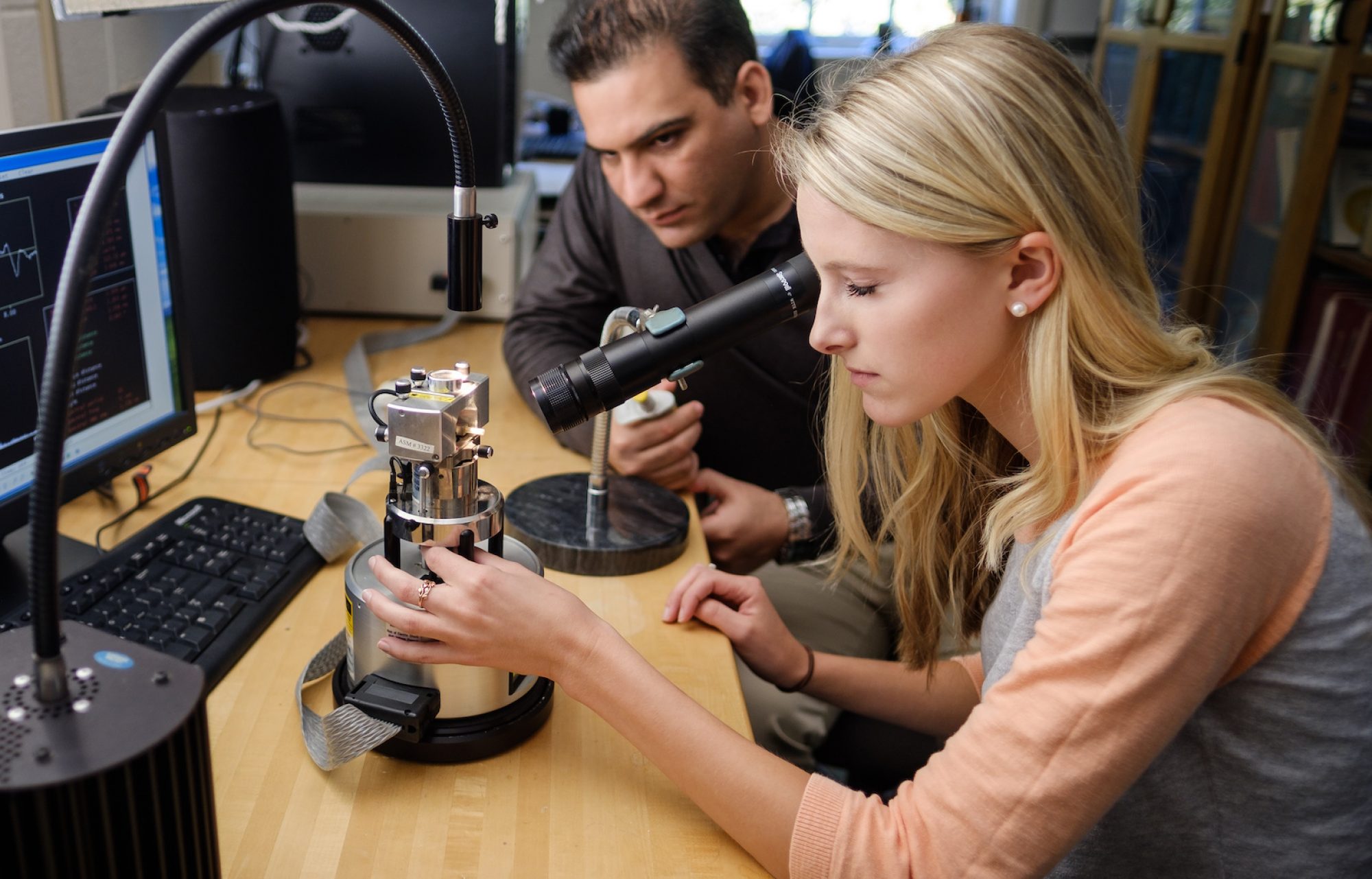
Drew Onken, PhD Candidate
Public Presentation in ZSR Library Auditorium, Room 404
Monday, July 23, 2018, at 2:00 PM
Richard Williams, PhD, Advisor


The defense will follow.


ABSTRACT

To address outstanding issues in the growth and performance of crystals for radiation detection, I develop and employ several material characterization techniques not previously implemented in the field. Two main, interconnected issues are addressed: the cracking of certain crystals during the growth process and spatial inhomogeneity in the defect distributions of radiation detector crystals. Although the purpose of these materials is to detect high-energy gamma rays, no gamma rays were used in these studies. Instead, much can be learned from the more precise interactions of low-energy photon and neutron beams.


The growth of single-crystal boules of certain semiconductors and scintillators can be plagued by cracking during post-growth cool-down. I have conducted proof-of-concept studies on a survey of laser techniques both to map thermal and chemical non-uniformity in situ as well as to perform laser ablation to separate material, to produce cleaner cuts, and to drive dislocation multiplication. In addition, neutron diffraction at high temperatures approaching the melting point can characterize the thermal and chemical stresses which can be exacerbated to the point of cracking by thermal gradients in the furnace.


After fabrication, asymmetries in the growth process can result in an inhomogeneous distribution of defects and dopants in the crystal. These non-uniformities in the crystal can have a significant impact on the energy resolution and degradation of the radiation detector. I construct a two-photon “multi-scope” and implement position-sensitive spectroscopic techniques to map the inhomogeneity of a crystal’s response, considering the origin of the inhomogeneity and the impact it has on detector performance. Finally, with an understanding of how spatial and energy density non-uniformity of response can affect energy resolution, digitized scintillation pulses are analyzed in an effort to extract extra information from the pulse shape in hopes of improving non-proportionality and energy resolution.

Jiajie Xiao, PhD Candidate
Public Presentation in Olin Physics Building, Room 101
Friday, June 15, 2018, at 1:oo PM
Fred Salsbury, PhD, Advisor


The defense will follow.


ABSTRACT

Thrombin is an attractive drug target for antithrombotic therapy and chemotherapeutic development due to its critical role in blood coagulation, as well as in cancer cell growth and metastasis. Many experiments have demonstrated that thrombin is a multifunctional allosteric enzyme, whose functions are regulated by the binding of effector molecule at a site other than the active site of the enzyme. However, the exact mechanism of thrombin’s allostery remains unclear and widely debated.

This work describes my application of molecular dynamics simulations and various quantitative methods to uncover thrombin’s allostery. It discusses thrombin’s allosteric responses to different factors including ion conditions, disease-associated mutations, and ligation statuses. My in-depth atomic-level investigation presents experimentally consistent results and provides mechanistic insights into thrombin’s functional switch. The generalized allostery should be the main mechanism of thrombin’s functional regulations. Several novel testable predictions further the understanding of thrombin’s substrate recognition process and allosteric pathways. The allosteric responses revealed in this work may be exploited in further drug discovery and development.

Our Departmental Reception will be held Sunday, May 20th, from 4:15-6:15pm (drop-in) to celebrate our 2018 graduating seniors!!!

Ahmad Al-Qawasmeh, PhD Candidate
Public Presentation in Olin Physics Building, Room 101
Tuesday, May 8, 2018, at 11:00 AM
Natalie Holzwarth, PhD, Advisor


The defense will follow.


ABSTRACT

The purpose of this work is to develop a detailed understanding of solid state electrolyte materials and to contribute to their development for possible use in Li ion batteries using the framework of first principles computational methods. In particular, we use different computational methods in the framework of density functional theory to perform an in depth study of the structure, Li ion conductivity, and the stability of recently reported promising inorganic solid electrolyte materials. The structure for some materials was reported from experiment and in some cases was predicted from the simulation and validated to be consistent with the experimental data. The Li ion conductivity was studied using the nudged elastic band method and molecular dynamics simulations. The nudged elastic band method was used to analyze the migration barrier of the Li ions. Molecular dynamics simulations were used to analyze the migration of the Li ions by visualizing superposed Li positions over the timescale and temperatures of the simulation and to calculate the ionic conductivity of the material from the mean square displacement of the Li ions. The stability was studied by analyzing the electronic structure of the interface of the material with metallic Li. Four classes of solid electrolytes identified as promising electrolytes in the recent experimental literature were investigated in this work. The first class of materials studied was the alloy system Li3+xAs1-xGexS4 (G. Sahu et al., Journal of Materials Chemistry A, 2, 10396 (2014)) where the simulations were able to model the effects of Ge in enhancing the conductivity of pure Li3AsS4. The second class of materials studied was Li4SnS4 and Li4SnSe4 (T. Kaib et al., Chemistry of Materials, 24, 2211(2012), J. A. MacNeil et al., Journal of Alloys and Compounds, 586, 736 (2013), T. Kaib et al., Chemistry of Materials, 25, 2961 (2013)). The simulations were able to identify the two different crystal structures of the materials and to investigate differences in their conduction properties. The third set of materials studied were two nitrogen rich crystalline lithium oxonitridophosphate materials, Li14P2O3N6 (D. Baumann et al., European Journal of Inorganic Chemistry, 2015, 617 (2015)) and Li7PN4 (W. Schnick et al., Journal of Solid State Chemistry, 37, 101 (1990)). The simulations were able to suggest that these materials are promising solid electrolytes due to their ideal interface properties with metallic Li and their promising ionic conductivity. The fourth project is an ongoing study of the newly synthesized electrolyte Li4PS4I (S. Sedlmaier et al., Chemistry of Materials, 29, 1830 (2017)). The simulations help in the understanding of the structural and ion mobility properties of this material and to study models of interfaces with Li metal.

WFU senior physics students will present highlights of their honors theses
George P. Williams, Jr. Lecture Hall, (Olin 101)
Wednesday, April 25, 2018, at 4:00 PM


There will be a reception with refreshments at 3:30 PM in the lounge. All interested persons are cordially invited to attend.

PROGRAM

  • Laura Jennings — Mentor: Prof. Jurchescu — “Effect of Solvent Vapor Annealing on the Performance of Solution Processed Thin Film Transistors.”
  • Zoe Hurtado — Mentor: Prof. Hall — “Quantifying 5-Hydroxymethylcytosine Content for Breast Cancer Detection using Solid-State Nanopores”
  • Josiah Low — Mentor: Prof. Guthold — “Quantification of Migratory Behavior in Cancerous and Noncancerous Human Mammary Cells”
  • Mary Kinney — Mentor: Prof. Guthold — “Turbidimetry Measurements of Plasma Clots from Healthy Males and Males with Cardiovascular Disease”
  • David Ostrowski — Mentor: Prof. Kim-Shapiro — “Effects of Nitrite and Hydroxyurea Combined Therapy on Sickle Cell Model Red Blood Cell Deformability”
  • Sajant Anand — Mentor: Prof. Jurchescu — “Investigating Traps in Organic Field-Effect Transistors through Field-Dependent Mobility”
  • Daniel Vickers — Mentor: Prof. Cook — “Resolving of Spin-Weighted Spheroidal Eigenvalues for Kerr Black Holes”

WFU senior physics students will present highlights of their honors theses; ΣΠΣ and Physics Awards Ceremonies will follow
George P. Williams, Jr. Lecture Hall, (Olin 101)
Wednesday, May 2, 2018, at 3:30 PM


There will be a reception with refreshments at 3:00 PM in the lounge. All interested persons are cordially invited to attend.

PROGRAM

    • Manal Ahmidouch — Mentor: Prof. Cho — “MD Simulations of (Benz)acridine: rDNA G-Quadruplex Complexes”
    • Caroline Kuczynski — Mentor: Prof. Cho — “Investigating the Effects of Posttranscriptional Chemical Modifications in tRNA on Molecular Communication Pathways in Arginyl-tRNA Synthetase:tRNAArg Complex”
    • Ben Scharmann — Mentor: Prof. Jurchescu — “Diodes on A Molecular Scale”
    • Katrina Barth — Mentor: Prof. Jurchescu — “Contact Effects in Organic Field-Effect Transistors”
    • Cenji Yu — Mentor: Prof. Salsbury — “The Effect of Sequence Variations on Thrombin Binding Aptamer”


  • Physics Honor Society (ΣΠΣ) Ceremony
  • Physics Awards Ceremony

P. Wilson Cauley, PhD;  School of Earth and Space Exploration, Arizona State University
George P. Williams, Jr. Lecture Hall, (Olin 101)
Wednesday, April 11, 2018, at 4:00 PM


There will be a reception with refreshments at 3:30 PM in the lounge. All interested persons are cordially invited to attend.


ABSTRACT

We are well into the Age of Exoplanets with approximately 4000 confirmed to date.  Efforts in exoplanet characterization have led to some very precise determinations of planetary densities, compositions, and even accurate maps of active region and spot locations on stellar surfaces.  Exoplanet magnetic fields, however, remain elusive.  While radio observations continue to push into the low-mass brown dwarf regime, no emission from a planetary-mass object has been confirmed.

I will discuss some of our efforts involving alternate methods for probing exoplanet magnetic fields and how they stack up so far against the prospects for detection via radio emission.

Junwei Xu
Public Presentation in Olin 101
Friday, March 30, 2018, at 10:00 AM
David L. Carroll, PhD, Advisor


The defense will follow.


ABSTRACT

Charge balance in organic light emitting structures is essential to simultaneously achieving high brightness and high efficiency. In DC-driven OLEDs, this is relatively straight forward. However, in the newly emerging, capacitive, field-activated AC-driven organic devices, charge balance can be a challenge. We introduced the concept of gating the compensation charge in AC-driven organic devices and demonstrated that this can result in exceptional increases in device performance. To do this we replaced the insulator layer in a typical field-activated organic light emitting device with a nanostructured, wide band gap semiconductor layer. This layer acts as a gate between the emitter layer and the voltage contact. Time resolved device characterization shows that, at high-frequencies (over 40,000Hz), the semiconductor layer allows for charge accumulation in the forward bias, light generating part of the AC cycle and charge compensation in the negative, quiescent part of the AC cycle.

We also showed that solution-grown films of CsPbBr3 pervoskite nanocrystals imbedded in wide band-gap Cs4PbBr6 can be incorporated as the recombination layer in light-emitting diode structures. More importantly, optical response was studied to shed light on why the very poor light emitter CsPbBr3 becomes a high-efficiency fast emitter when imbedded as nanocrystals in the wider gap host Cs4PbBr6.  Kinetics at high carrier density of pure (extended) CsPbBr3 and the nano-inclusion composite were measured and analyzed, indicating second order kinetics in extended and mainly first order kinetics in the confined CsPbBr3, respectively. In these terms, the nano-confinement might be viewed as enforcing mainly geminate recombination of electrons and holes in a material (CsPbBr3) that did not support stable excitons at room temperature.  The resulting first-order recombination competes with trapping much more effectively than does bimolecular recombination at the moderate carrier densities typical of LEDs and usual photo-excitation.  Analysis of absorption strength of this all-perovskite, all-inorganic imbedded nanocrystal composite relative to pure CsPbBr3 indicated enhanced oscillator strength consistent with earlier published attribution of the subnanosecond exciton radiative lifetime in nano-precipitates of CsPbBr3 in melt-grown CsBr host crystals and CsPbBr3 evaporated films.

Dr. Christopher Tycner, Professor and Chair, Department of Physics, College of Science and Engineering at Central Michigan University
George P. Williams, Jr. Lecture Hall, (Olin 101)
Wednesday, April 4, 2018, at 4:00 PM


There will be a reception with refreshments at 3:30 PM in the lounge. All interested persons are cordially invited to attend.


ABSTRACT

Long-baseline optical and IR interferometers now routinely resolve the disk and disk-like structures around stars.  The typical angular scales resolved by current generation of instruments are at the sub-milli-arcsecond level. In this presentation, I will introduce the fundamental principles behind long-baseline optical interferometry, as well as describe the practical implementation based on the Navy Precision Optical Interferometer (NPOI), a joint project between the U.S. Naval Observatory, Navy Research Laboratory, and Lowell Observatory. Specific examples of observations obtained at the NPOI of spatially resolved circumstellar disks will be presented.

I will describe how interferometric observations with complementary spectroscopic data are used to constrain the numerical models of circumstellar disks.  Such tests can in turn be used to determine the physical properties of the disks, investigate rotationally enhanced mass-loss processes, and study the effects of a secondary star on a circumprimary disk in binaries.

Printable Version


Jason Howard, PhD Candidate
Public Presentation in Olin 107
Tuesday, April 17, 2018, at 2:00 PM
Natalie Holzwarth, PhD Advisor


The defense will follow.


ABSTRACT

In this work materials with possible applications in all solid state Li-ion batteries are explored using computational methods within the framework of density functional theory and kinetic Monte-Carlo. The density functional theory simulations use fundamental quantum mechanics along with some approximations to produce accurate models of real materials. A smaller portion of the work uses kinetic Monte Carlo to provide qualitative information about the convergence properties of transport coefficients. The materials Li2+xSnO3 and Li2+xSnS3 are studied in the context of electrodes for Li-ion batteries. Their structures are calculated, conduction pathways for the Li-ions predicted, open cell voltages calculated, and reactivity with lithium at the surface studied. The results for these materials provided insight into existing experimental data from the literature and made predictions for open cell voltages that had not yet been measured. The materials Li4SnS4, Li2OHCl and Li2OHBr are studied in the context of  solid state electrolytes for Li-ion batteries. The structural properties are explored for some materials by calculating Helmholtz free energies   to help understand temperature dependent phases. First-principles molecular dynamics are performed on some of these materials to gain insight into the mechanisms for Li-ion diffusion, which is related to the Li-ion conductivity. The molecular dynamics simulations of these materials are also used to calculate order parameters, such as time averaged site occupancy, which provide insight into temperature dependent aspects of their structure. The computations using kinetic Monte-Carlo are limited to the study of the convergence properties of transport coefficients on a lattice equivalent to the Li lattice of Li2OHCl. These Monte-Carlo simulations provide critical insight on the level of statistics needed to converge the transport coefficients related to ionic conductivity. As a whole the simulations in this research provide atomistic level knowledge of real world energy storage materials.