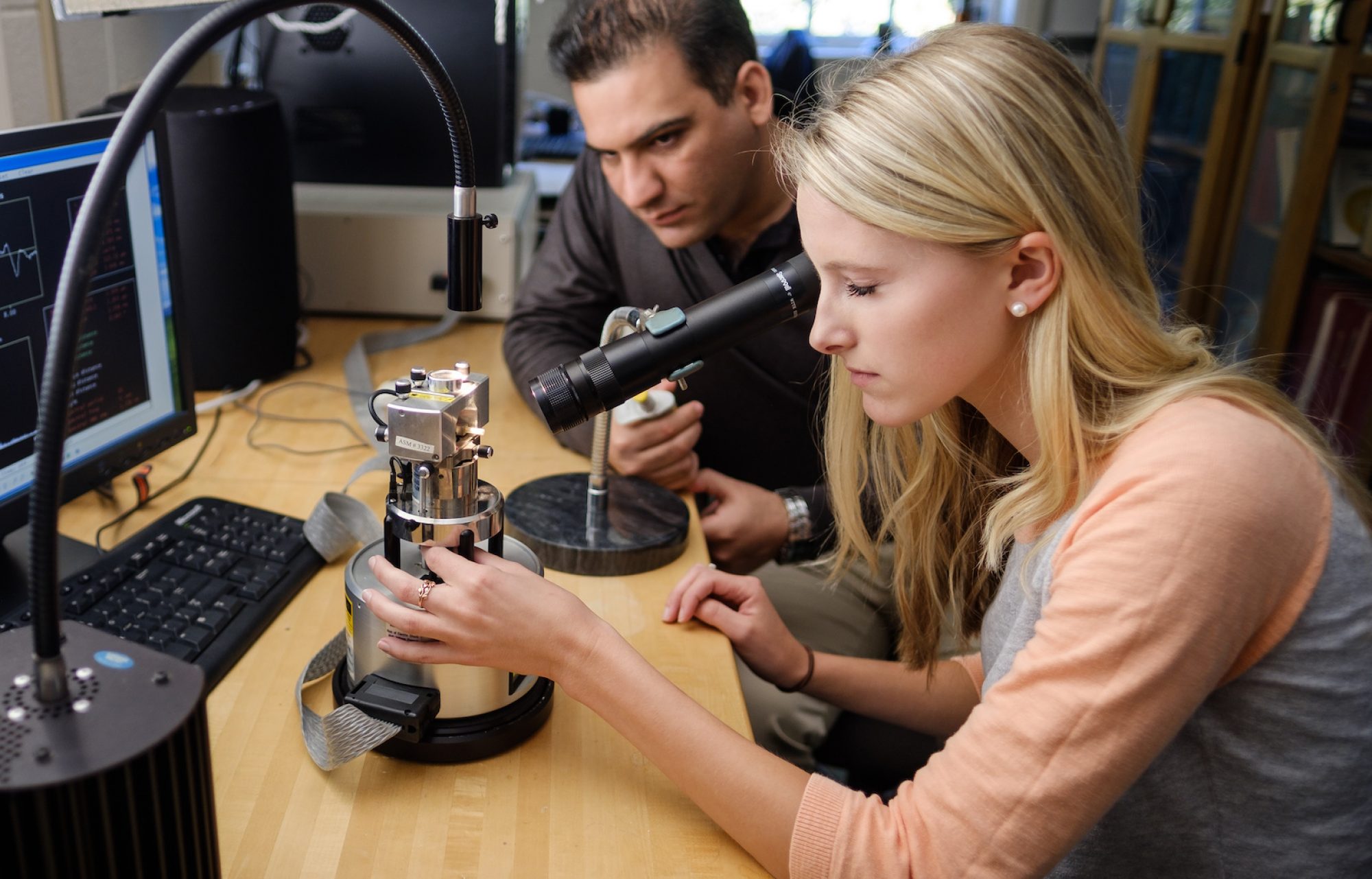
David Montgomery, PhD Candidate
Public Presentation in Olin 107
Monday, April 9, 2018, at 12:00 PM
David L. Carroll, PhD, Advisor


The defense will follow.


ABSTRACT

This work focuses on the combination of thermoelectric and piezoelectric materials into a new hybrid generator. It was discovered that a hybrid thermoelectric piezoelectric generator results in a meta-structure that creates a coupling field effect at the interface between the thermoelectric and piezoelectric films that produces more power than the sum of the individual generators. This coupling field effect causes a modification of the thermoelectric properties causing an observed 468% increase in total power output. In addition to this coupling effect, the first functional thermoelectric and piezoelectric generator design is presented. This is achieved by integrating a flexible continuous alternating p- and n-type semiconductor thermoelectric generator into the electrode of the piezoelectric film.  This design overcomes major issues previously preventing the two materials to be combined in a single generator architecture. This functional thermoelectric piezoelectric generator can achieve 89% of the theoretical thermoelectric power and 540% increase in the piezoelectric power due to the geometry of the structure. A spray doping synthesis method is presented that was used to create the continuous alternating p- and n-type semiconductor film. Spray doping achieves that same thermoelectric properties of solution doping but greatly simplifies the fabrication of a thermoelectric generator. Finally an optimized thermoelectric generator is presented that overcomes many of the current issues plaguing other thin film designs. The optimized structure is robust and is compatible with numerous synthesis methods and materials used in thin film thermoelectrics.

Professor Hanli Liu, Professor of Bioengineering; Distinguished University Professor; Fellow, American Institute for Medical and Biological Engineering; University of Texas at Arlington
George P. Williams, Jr. Lecture Hall, (Olin 101)
Wed. Mar. 28, 2018, at 4:00 PM


There will be a reception with refreshments at 3:30 PM in the lounge. All interested persons are cordially invited to attend.


ABSTRACT

In recent years, different forms of non-invasive, transcranial brain
stimulations, such as transcranial magnetic stimulation (TMS),
transcranial direct current stimulation (tDCS) and transcranial
alternate current stimulation (tACS), have been investigated as
promising neuromodulation tools to treat a variety of neurological
brain disorders. Furthermore, transcranial photobiomodulation
(tPBM) using NIR laser or light emitting diodes (LEDs) has also
demonstrated promises to improve human memory and cognition.
However, underlying principles or mechanisms of these transcranial
brain stimulations are not well understood. It is urgent and
necessary to investigate stimulation-induced changes in cerebral
hemodynamics and brain circuitry.

In this talk, I will present three sub-topics of research in studying
tPBM by 1064-nm laser delivered on the human forehead: (1) A
brief review will be given to show statistically significant
enhancement of human cognition by 1064-nm laser over more than
300 human subjects. (2) Quantitative evidence on upregulation of
cerebral cytochrome-c-oxidase and hemodynamics in response to
tPBM will be explained. (3) Significant alterations in tPBM-induced
electrophysiological patterns across the entire human head,
determined by 64-channel EEG measurements, will be
demonstrated. For the last topic, I will also show what direction of
information flow occurs before, during, and after tPBM by applying
the Phase Transfer Entropy (PTE) analysis on multi-channel EEG
measurements. Overall, this talk intends to shed light on the
mechanism of action of tPBM, which may have great potential to
become a non-invasive, low-cost, intervention device for improving
human cognition in the near future.

Printable Version

Professor Walter Bradley, Emeritus Distinguished Professor of Mechanical Engineering, Baylor University & Emeritus Professor of Mechanical Engineering, Texas A&M University
George P. Williams, Jr. Lecture Hall, (Olin 101)
Wed. Mar. 21, 2018, at 4:00 PM


There will be a reception with refreshments at 3:30 PM in the lounge. All interested persons are cordially invited to attend.


ABSTRACT

There is a growing interest in the use of renewable functional fillers in polymer composites and natural fibers in non-woven fabric composites to make more environmentally friendly products by reducing the use of petroleum. This can be done using crops such as kenaf that are grown for this purpose. However, the use of agricultural waste has two advantages: the feedstock is essentially free and the volume of agricultural waste to be burned or buried is reduced. This presentation will explore the possibilities of using coconut shell and coconut husks as feed stocks to make functional fillers for polymeric composite materials and non-woven fabric composites respectively. The properties of the coconut shell and fiber from the coconut husk (called coir) will be presented. Commercial applications that can take advantage of these families of physical properties will be used to illustrate a wider range of possibilities. The necessary materials science research that was performed to make possible their incorporation into commercial products will also be summarized.

printable version

Ryan Melvin.
Public Presentation in Olin 107.
Mon. Mar. 19, 2018, at 2:00 PM.
Freddie R. Salsbury, Jr., Advisor.


The defense will follow.


ABSTRACT

Applying statistical and machine learning, I have addressed key issues in the field of computational biophysics. The guiding principle in this work has been removing bias and conveying uncertainty. To that end, I have contributed numerous methods for interpreting biopolymer ensemble data without the need for prior knowledge or setting of biasing parameters. Additionally, in all of these works, I have provided a careful discussion of the limits of these methods and how researchers might visually convey the inherent uncertainty, including displaying what are effectively error bars on biopolymer structures. I have worked to remove bias even in estimating the amount of sampling needed for any time-dependent multi-dimensional process. These contributions may move the field forward in its ability to remove bias and convey uncertainty in statistically rigorous ways.


After introducing these methods, I proceed with applications of them to the study of a chemotherapeutic nucleic acid called F10 – a 10mer of 5-fluoro-2′-deoxyuridine-5′-O-monophosphate. Here I uncover the mechanism for a previously observed interaction with zinc and magnesium, leading to a general investigation of F10’s interactions with metal ions. I conclude by proposing a stabilizing chemical perturbation to the polymer and discussing implications for drug delivery.

Ryan Melvin.
PhD Candidate, Department of Physics, Wake Forest University.
George P. Williams, Jr. Lecture Hall, (Olin 101)
Wed. Mar. 14, 2018, at 4:00 PM


There will be a reception with refreshments at 3:30 PM in the lounge. All interested persons are cordially invited to attend.


ABSTRACT

Applying statistical and machine learning, I have addressed key issues in the field of computational biophysics. The guiding principle in this work has been removing bias and conveying uncertainty. To that end, I have contributed numerous methods for interpreting biopolymer ensemble data without the need for prior knowledge or setting of biasing parameters. Additionally, in all of these works, I have provided a careful discussion of the limits of these methods and how researchers might visually convey the inherent uncertainty, including displaying what are effectively error bars on biopolymer structures. I have worked to remove bias even in estimating the amount of sampling needed for any time-dependent multi-dimensional process. These contributions may move the field forward in its ability to remove bias and convey uncertainty in statistically rigorous ways.


After introducing these methods, I proceed with applications of them to the study of a chemotherapeutic nucleic acid called F10 – a 10mer of 5-fluoro-2′-deoxyuridine-5′-O-monophosphate. Here I uncover the mechanism for a previously observed interaction with zinc and magnesium, leading to a general investigation of F10’s interactions with metal ions. I conclude by proposing a stabilizing chemical perturbation to the polymer and discussing implications for drug delivery.

This thesis work has been mentored by Professor Fred Salsbury. The PhD thesis defense will take place on March 19, 2018.

Printable Version

WFU Physics Colloquium

TITLE: “Electronic Stopping in Condensed Matter: Understanding Electronic Excitation Dynamics under Proton Irradiation”
SPEAKER: Professor Yosuke Kanai
University of North Carolina at Chapel Hill

TIME: Wed. Feb. 28, 2018, at 4:00 PM
PLACE: George P. Williams, Jr. Lecture Hall, (Olin 101)


There will be a reception with refreshments at 3:30 PM in the lounge. All interested persons are cordially invited to attend.


ABSTRACT

Transfer of the energy/momentum from highly-energetic ions to electrons in condensed matter is described by the so-called electronic stopping. The projectile ions bear highly localized electric field that is quite heterogeneous at the atomistic scale, and massive electronic excitations are produced in the electronic stopping process. Understanding this phenomenon in condensed matter systems under proton and other ion irradiation has implications in various modern technologies, ranging from nuclear fission/fusion reactors, to semiconductor devices for aerospace missions, to cancer therapy based on proton beam radiation. Electronic stopping has been long studied within linear response theory framework (e.g. Bethe theory), but recent advances in high-performance computers allow us to study the phenomena beyond such simplified treatment through the use of numerical simulations. In this talk, I will discuss how non-equilibrium dynamics simulations based on our recently-developed large-scale real-time time-dependent density functional theory enable us to study this electronic excitation process, using an important case of liquid water under proton irradiation as an example. In addition to determining the energy transfer rate (i.e. electronic stopping power), our work reveals several key features of the excitation dynamics at the mesoscopic and molecular levels for deciphering water radiolysis mechanism under proton irradiation.

printable version

WFU Physics Colloquium

TITLE: “Why is Lettuce So Wrinkly?”
SPEAKER: Professor John Gemmer
Assistant Professor, Department of Mathematics and Statistics
Wake Forest University

TIME: Wed. Feb. 21, 2018, at 4:00 PM
PLACE: George P. Williams, Jr. Lecture Hall, (Olin 101)


There will be a reception with refreshments at 3:30 PM in the lounge. All interested persons are cordially invited to attend.


ABSTRACT

Many patterns in nature and industry arise from the system minimizing an appropriate energy. Examples range from the periodic rippling in hanging drapes to the six-fold symmetries observed in snowflakes. Torn plastic sheets and growing leaves provide striking examples of pattern forming systems which can transition from single wavelength geometries (hosta leaves) to complex fractal like shapes (lettuce). These fractal-like patterns seem to have many length scales – the same amount of extra detail can be seen when looking closer (“statistical self-similarity”). It is a mystery how such complex patterns could arise from energy minimization alone.

In this talk, I will address this puzzle by showing that such patterns naturally arise from the sheet adopting a hyperbolic non-Euclidean geometry. However, there are many different hyperbolic geometries that the growing leaf could select. I will show, using techniques from nonlinear elasticity, analysis, differential geometry and numerical optimization, that the fractal-like patterns are indeed the natural minimizers for the system.

WFU Physics Colloquium

TITLE: “Converting Agricultural Waste into Value-Added Products:  The Case of the Coconut”
SPEAKER: Professor Walter Bradley, PhD, PE
Emeritus Distinguished Professor of Mechanical Engineering, Baylor University
Emeritus Professor of Mechanical Engineering, Texas A&M University

TIME: Wed. Mar. 21, 2018, at 4:00 PM
PLACE: George P. Williams, Jr. Lecture Hall, (Olin 101)


There will be a reception with refreshments at 3:30 PM in the lounge. All interested persons are cordially invited to attend.


ABSTRACT

There is a growing interest in the use of renewable functional fillers in polymer composites and natural fibers in non-woven fabric composites to make more environmentally friendly products by reducing the use of petroleum.  This can be done using crops such as kenaf that are grown for this purpose. However, the use of agricultural waste has two advantages: the feedstock is essentially free and the volume of agricultural waste to be burned or buried is reduced.  This presentation will explore the possibilities of using coconut shell and coconut husks as feed stocks to make functional fillers for polymeric composite materials and non-woven fabric composites respectively.  The properties of the coconut shell and fiber from the coconut husk (called coir) will be presented.  Commercial applications that can take advantage of these families of physical properties will be used to illustrate a wider range of possibilities. The necessary materials science research that was performed to make possible their incorporation into commercial products will also be summarized.

printable version

WFU Physics Career Advising Event

SPEAKER: Dillon Sanders

Department of Nuclear Engineering
NC State University
and Wake Forest Alum

TIME: Wednesday, February 14, 2018 at 12:00 – 1:00 PM

PLACE: Olin Lounge (Olin 106)


Pizza will be provided. All interested persons are cordially invited to attend.


BIO & TOPICS

Mr. Sanders is nearing the completion of his Ph.D. in Nuclear Engineering at North Carolina State University. He obtained his B.S. in Physics from Wake Forest University in 2012. His research has involved the study of nuclear materials primarily using computer simulations.

In this lunch seminar, we will discuss the numerous opportunities for students in the physics curriculum to pursue educational advancement in engineering graduate programs as well as careers in the nuclear industry. Discussion topics will include: The applicability of skills learned in the WFU Physics Department to engineering disciplines; internship opportunities for undergraduates and graduate students at various national laboratories, nuclear vendors, and the U.S. Armed Forces; and careers in public policy and national/international nuclear safeguards. As Mr. Sanders has transitioned from a physics background to engineering, students interested in applying their physics skills to engineering disciplines are encouraged to attend. As the word “nuclear” is appearing in the news with increasing frequency today, anyone with general questions about the functionality and application of nuclear technology is welcome to attend as well. The seminar will be informal and will conclude with a question and answer session.

printable version

WFU Physics Colloquium

TITLE: “Properties and Dynamics of Jammed Matter: Insights from Simulations”
SPEAKER: Mr. Dillon Sanders
Department of Nuclear Engineering
North Carolina State University

TIME: Wed. Feb. 14, 2018, at 4:00 PM
PLACE: George P. Williams, Jr. Lecture Hall, (Olin 101)


There will be a reception with refreshments at 3:30 PM in the lounge. All interested persons are cordially invited to attend.


ABSTRACT

Systems governed by jammed dynamics are ubiquitous in nature and range from the molecular motion in glassy materials to the movement of cars in traffic jams. Theories and experiments that elucidate the underlying causes of the glass transition have led to the observation of universal behaviors, such as dynamical heterogeneity and string-like cooperative motion, that are seen in a variety of jammed systems and have been studied in detail using molecular dynamics (MD) simulations.

In this talk, I will describe efforts to unite dynamic and thermodynamic features of glass-forming liquids in the context of MD, and the extension of these efforts to describe other seemingly different systems such as superionic solids and irradiated crystals.

Printable version